
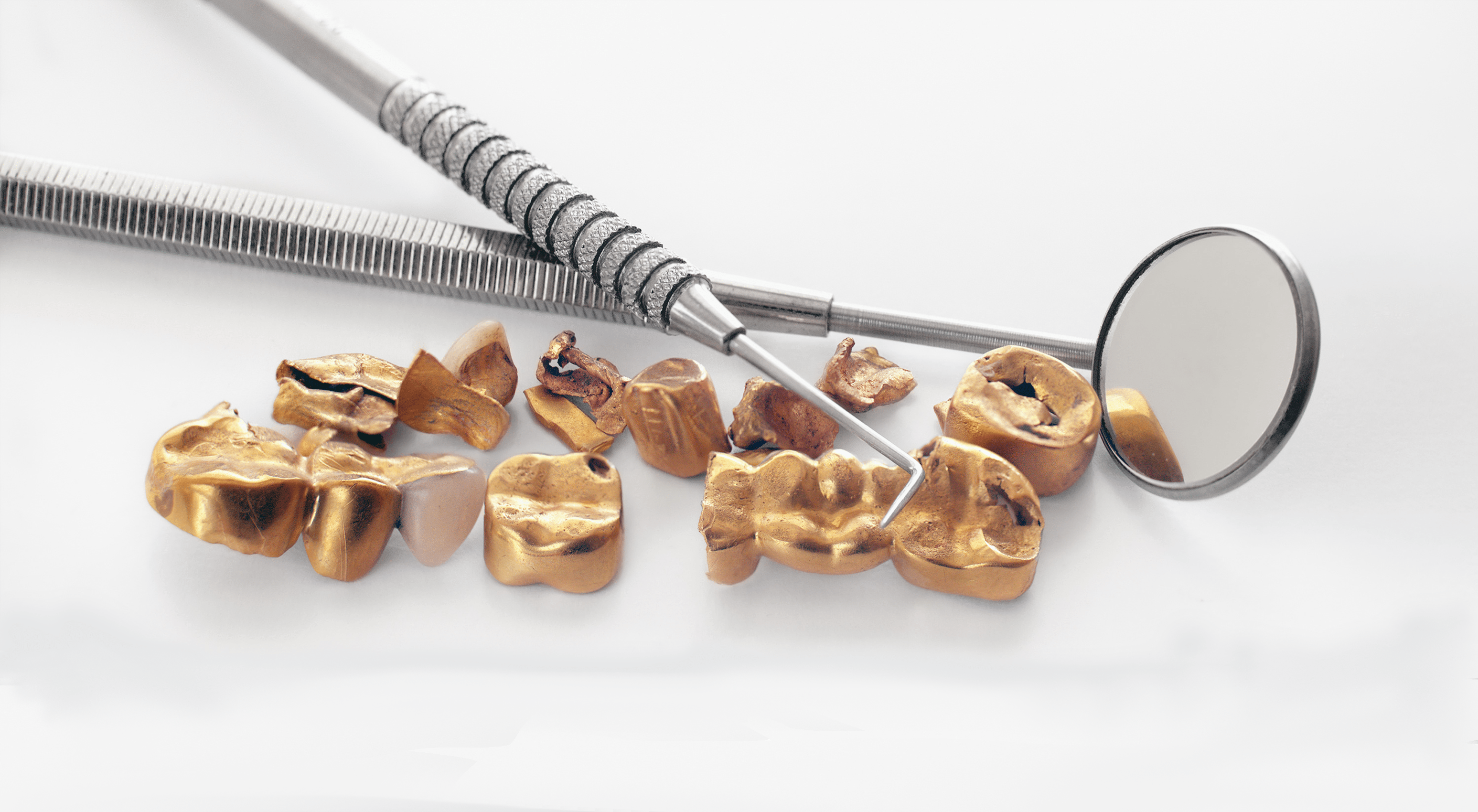
People typically associate gold with jewelry, coins and bars. But did you know that a significant portion of the world’s gold is also used in medicine and dentistry? Gold has been used for dental work since ancient times – and while it’s less common today, it’s unlikely that dentists will ever fully part ways with precious metals.
gold will ever completely disappear from the dental industry.
Gold alloys are used to make crowns, bridges, inlays/onlays, implants and other objects for restorative dental procedures. Sometimes gold is used for fun dental projects, too – like bedazzling one’s smile with tooth jewelry.
Whether used clinically or aesthetically, gold is trusted by dental professionals because it’s highly durable and biocompatible, making the metal ideal for long-term use inside the oral cavity.
Types of Dental Gold: Crowns, Bridges and More
Precious metals like gold, silver, platinum and palladium are used in dental bridges, crowns, implants and more.
Chances are you’ve heard of a gold crown. Crowns are a type of dental repair in which a tooth or multiple teeth are covered for protection, usually due to a weak or cracked tooth.
A bridge is a type of treatment that uses one or more artificial teeth, referred to as pontics, to replace missing teeth. Pontics are held in place by crowns that are placed on the neighboring teeth. Several components of dental bridges, including pontics and the crowns that connect them, can be made from gold alloys, porcelain, or a combination.
Dental implants are essentially artificial tooth roots that are surgically attached to the jawbone. Over the course of several months, the bone surrounding the implant grows, holding it firmly in place. Then replacement teeth are attached to the implant with a metal connector, which is often made of titanium. While titanium is more traditional, gold is also an option with high durability – and some people prefer gold’s aesthetic appeal.
How Pure is Dental Gold?
Crowns, bridges and implants are just a few examples of dental restorations that use gold. But just how much gold does a single gold crown typically contain?
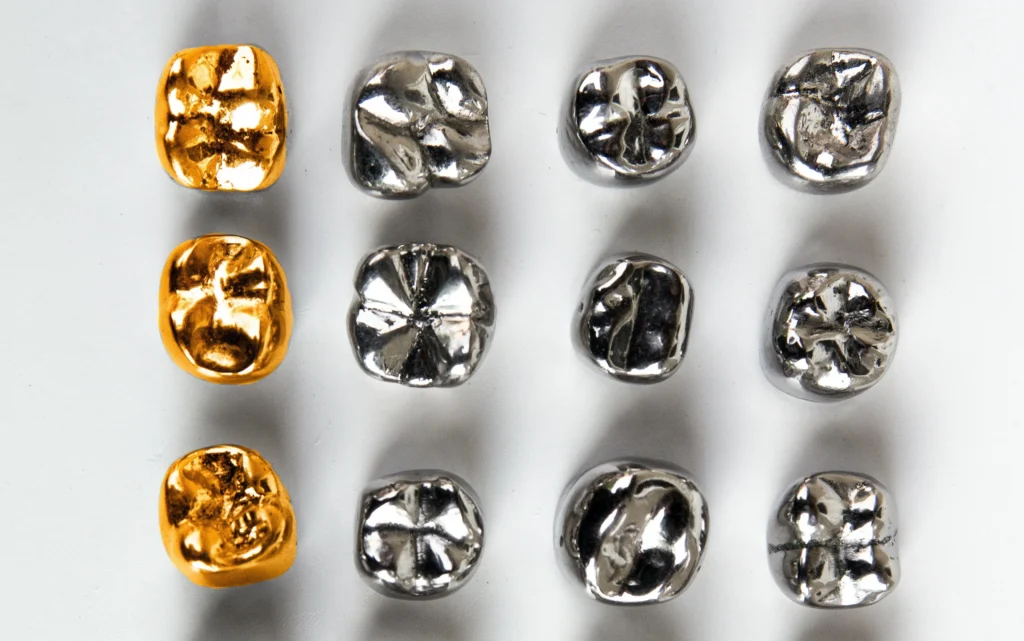
The gold used in dentistry is never fully pure (24k), because pure gold is too soft to withstand daily wear-and-tear inside a patient’s mouth. In order to boost strength and durability, pure gold is combined with other metals like palladium, platinum, silver, copper, nickel and more.
The karat value of a piece of dental gold can range widely depending on when and where the item was manufactured. Older dental crowns often contain more gold than the newer versions. Some gold crowns rank as high as 18 karats.
When a dental crown is made of at least 60% precious metals, with gold being the predominant element, it’s classified as a “high noble” alloy.
Not all gold-containing dental material is yellow in color – sometimes white gold alloys are used as well. So don’t let silver-colored crowns or bridges fool you – they could still contain gold, or other valuable metals like platinum/palladium!
Is Dental Gold Still Common?
Dentists still use gold for restorations, but not nearly as often as they did in previous decades. According to the Chicago Tribune, until about 14 years ago, roughly 67 metric tons of gold were used annually to make dental fillings, caps and crowns. Over the past 5-7 years, the demand for gold in dentistry has decreased nearly 60 percent.
Experts attribute gold’s reduced demand to several factors, including trends towards whiter teeth and advancements in dental ceramics like porcelain crowns and composite resin fillings. Gold’s higher price also makes it a less economical option.
Why Do Dentists Still Use Gold?
Given the array of newer options on the market and gold’s soaring prices, one might wonder why dentists still use gold at all. Gold may be the least natural-looking material for dental work, but it still offers superior strength and durability, giving the metal an edge over porcelain and other ceramic materials. Gold crowns and fillings can last up to 50 years with proper care, as much as 2-3 times longer than other materials! Opting for gold is a great way to avoid future time in the dentist’s chair.
Gold alloys best endure the forces of chewing, biting and grinding. Gold is strong enough to withstand even the heaviest human bite without chipping or cracking. That’s pretty impressive, considering that the average human bite strength is about 162 pounds per square inch.
Furthermore, gold alloys don’t wear down the opposing teeth, which is especially important for people who grind their teeth. Gold is also chemically stable and exceptionally resistant to acidity, bacteria, oxidation and corrosion. It’s compatible with human tissue like the gums, so it won’t cause any adverse reactions.
Last but not least, gold is very malleable. It can easily be formed and fitted precisely around or in place of a tooth without leaving any gaps. Dentists can preserve more of a patient’s natural tooth structure when placing a gold crown compared to other materials.
When is Gold Preferred?
Despite gold’s functional benefits, many patients prefer other materials for aesthetic reasons. Porcelain and ceramic crowns can match the rest of one’s smile almost perfectly, offering a natural appearance.
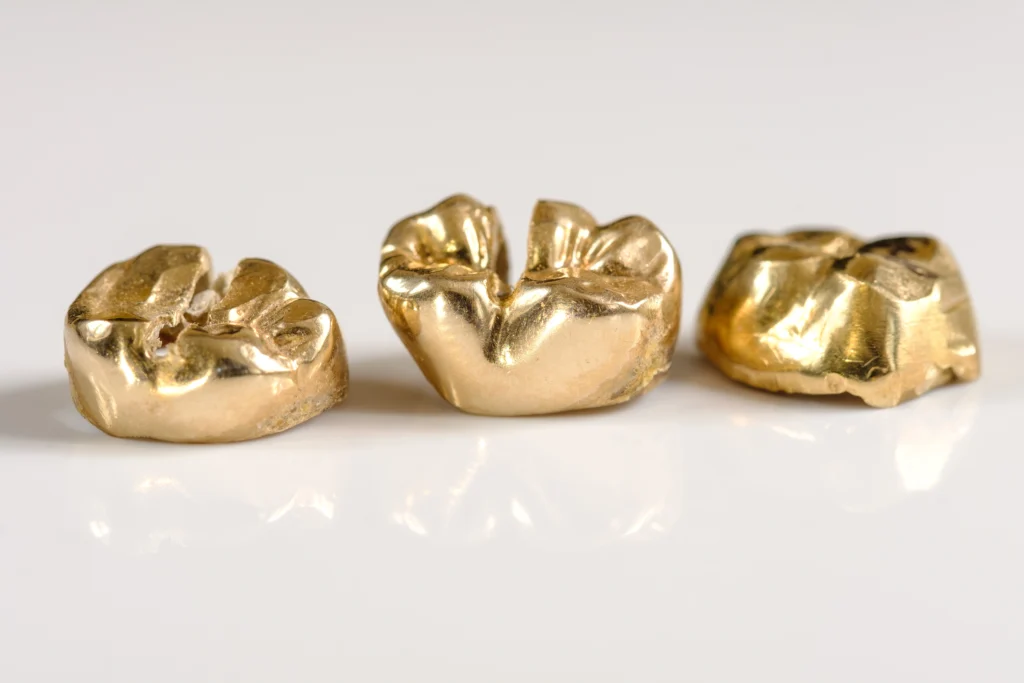
But depending on where work is needed inside the mouth, gold makes more sense than other non-metal materials in certain scenarios. For example: a molar that is not visible when you smile doesn’t really need a natural-looking crown or filling. Instead, it’s smart to use the strongest material possible, because the molar area withstands the most pressure from chewing and biting. In cases like this, gold is very practical.
All in all, gold is still preferred in clinical cases where strength, durability and biocompatibility are priorities.
Recycling Dental Gold
Dental gold is a valuable resource that should never end up in landfills. Recycling precious metal dental scrap can help reduce the demand for newly-mined metals, indirectly helping to offset the environmental impact associated with mining. Additionally, old dental material may contain other deleterious materials that are best handled through recycling.
Whether it’s a crown, bridge, implant or another item, the precious metals inside can be extracted, refined and repurposed for new use. While many gold-buying businesses are willing to purchase dental scrap, working with a true refinery – like Garfield Refining – ensures precise testing, accurate metal breakdowns, and most importantly, the highest payouts.
Where Should I Sell My Dental Scrap?
If you ever find yourself with unwanted dental gold or other precious metal restorations, you can easily monetize your scrap by sending it to Garfield Refining. We’ve been voted ‘Best Refiner’ by Dentaltown Magazine for fifteen years straight, thanks to our industry-leading payouts and exceptional service.
We accept all forms of dental scrap, including crowns, bridges, PFMs, inlays and onlays, partial dentures and dental implants. If you’re looking to reduce landfill waste while earning more for your metals, look no further than Garfield!
Ready to sell your precious metal scrap? Get started today with a free shipping label!