

Last Updated: August 14, 2026
Do you or a loved one have a gold crown in your mouth, or maybe one that’s been extracted and tucked away in a drawer somewhere? If so, that small dental restoration could be worth more than you think – especially in today’s booming precious metals market.
Common dental restorations like crowns, caps, and bridges often contain valuable metals like gold, silver, platinum, and palladium. Instead of letting them sit unused, sending these items to a precious metals refinery ensures that they’re properly recycled. Plus, you can earn some extra cash in the process. Dental scrap refining is both sustainable and lucrative.
Precious Metal Prices
Part of what’s driving interest in gold scrap right now is the strength of the precious metals market.
The price of gold has increased by about 80% over the past year, and the metal is currently trading at over $5,000 per troy ounce! Meanwhile, silver prices have tripled since early 2025. And in the same time frame, palladium has almost doubled, while platinum has more than doubled. The precious metals market has seen truly remarkable growth lately.
Precious Extractions: Keeping Your Scrap
If you ever have a precious-metal crown or other item extracted for replacement, be sure to ask your dentist if you can keep it. You may be able to refine it for cash.
Dentists are generally expected to return extracted dental crowns to patients upon request. While there’s no specific law requiring dentists return extractions, there’s also no law prohibiting it. In fact, the CDC confirms that dentists are permitted to return extracted materials to patients. Besides, it’s typically considered best practice to honor the patient’s wishes.
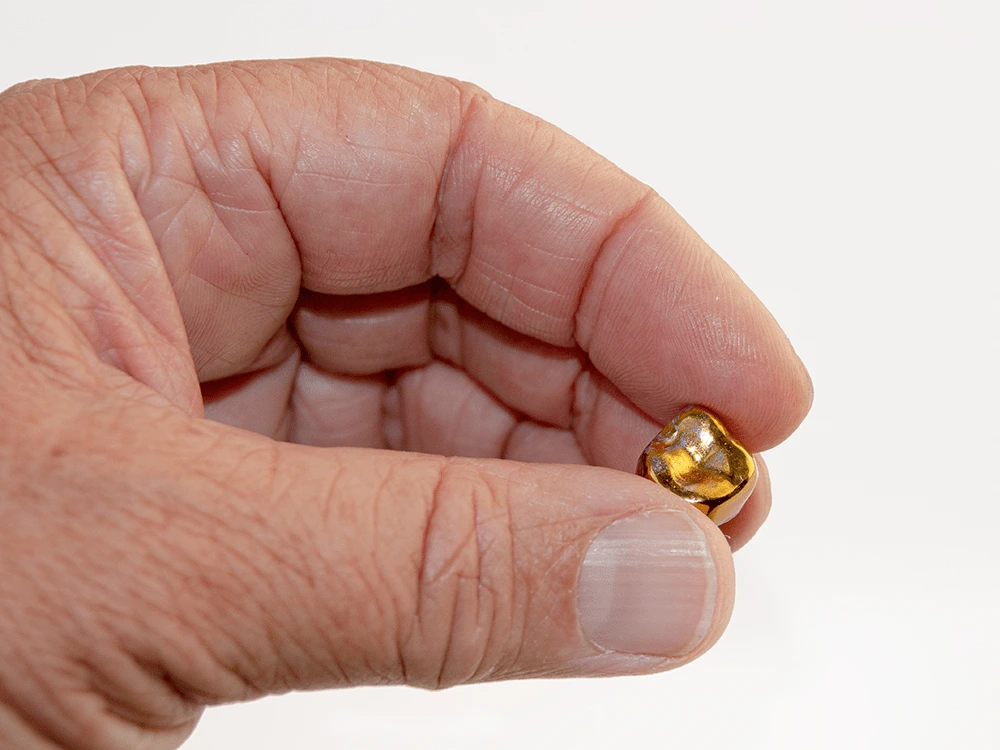
Different Types of Gold Crowns
Gold crowns are never made from 100% pure gold. Pure gold is simply too soft to withstand the daily forces of chewing and biting. (In fact, most gold jewelry isn’t 100% pure for the same reason – it would scratch and dent too easily.)
Instead, metal dental crowns are made from alloys – combinations of metals that often include both precious and non-precious components.
There are three main types of metal crowns: high noble alloys, noble alloys and non-noble alloys. High noble alloys are made from a minimum of 60% precious metals, with gold being the predominant component. Noble alloys contain at least 25% precious metal, and non-noble alloys contain less than 25% precious metal.
How Much Gold is in a Dental Crown?
The amount of gold in a single dental crown can vary significantly depending on the type of crown. For instance, an all-metal crown made from a high-noble alloy may contain around 67% gold. In contrast, a porcelain-fused-to-metal (PFM) crown typically has a thin layer of metal beneath a porcelain exterior, resulting in a much lower overall gold content.
Generally speaking, older crowns are more likely to have higher gold content. Before the 1980s, high-noble gold-based alloys were commonly used due to their durability and biocompatibility. But as gold prices rose, dentists began shifting to more affordable alternatives. Today, lower-gold alloys, non-precious metals, and materials like porcelain, zirconia, and resin are far more common. Simply put, they don’t make dental crowns like they used to!
How Much Do Gold Crowns Sell For?
At Garfield Refining, we purchase extracted dental crowns, bridges, PFMs, inlays/onlays and more from dentists and patients alike. Crowns and bridges are among the most common materials we receive.
Kelsey Spencer, Senior Account Manager in our Dental Department, has processed hundreds of dental scrap shipments and shares insight into the value of a single gold crown. “A crown’s value will depend on a number of factors, including when it was made and the lab/dentist who made it. I’ve seen crowns worth as much as $50, but typically they range from $10-$30. These days you see a lot more nickel and chrome because gold and palladium have become so valuable.”
Determining the Value of Dental Scrap
Most dentists don’t know the exact metal composition of the crowns they extract, since they’re usually outsourced and fabricated by specialized dental laboratories. Unless you’re the lab technician who made the crown – or the refiner who melts and assays it – it’s nearly impossible to know exactly how much gold it contains.
Dental crowns aren’t like jewelry with straightforward karat stamps to indicate purity. Jessica Kolber, Director of Account Services at Garfield, explains: “Dental crowns are not usually stamped. In the rare cases where a stamp is present, it doesn’t provide the exact percentages of gold, silver, platinum, palladium, or other metals contained in the alloy. A karat stamp only indicates the intended composition of the alloy when it was manufactured, and it doesn’t guarantee the actual precious metal content of the crown. Because dental alloys can vary significantly in composition, neither a stamp nor a visual inspection can accurately determine a crown’s precious metal content or value.”
That’s why dental scrap can’t be accurately valued through visual inspection alone. Proper testing is needed to determine the makeup of the alloy. Precious metal refineries like Garfield, which specialize in dental refining, perform a melt and assay to accurately determine the type and quantity of precious metals in each piece.
How Do I Sell My Dental Crown?
Selling a gold crown to a refinery like Garfield is simple. Fill out a quick form on our website and we’ll send you free shipping materials to mail your scrap to us.
Once your material is received, we’ll carefully assay it to determine the precious metal content, then calculate its value based on current market prices. Payment is typically issued within just 1–2 business days.
While all refineries charge a small fee to cover operating costs, Garfield takes pride in delivering the industry’s lowest refining fees, resulting in the highest payouts for our clients. We’re also known for providing exceptional customer service, which is why we’ve been named ‘Best Refiner’ by Dentaltown Magazine for 15 years straight!
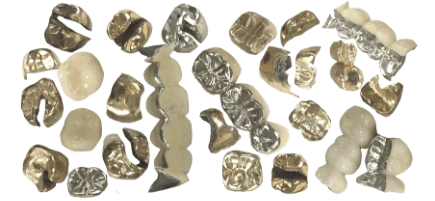
Can I Sell My Other Dental Scrap?
Garfield accepts all types of dental scrap that contain precious metals, including:
- – Dental crowns
- – Bridges
- – PFMs
- – Inlays and onlays
- – Partial dentures
- – Dental implants
We accept dental material as-is, so there’s no need to clean your scrap before sending it in. Whether you have a sizable collection of dental material or just a single cap or dental crown, we’re here to help you turn your scrap into cash – fast!
Garfield Refining has been refining precious metals since 1892. We’ll get you the best value for your gold, silver, platinum, and palladium. If you’d like to sell a gold dental crown, download a free shipping label to get started today.
Stay tuned to Garfield’s blog for more articles about precious metals like 3 Fun Facts about Gold and The Major Factors that Drive the Gold Price.
Written by
Allie BowmanAllie Bowman is the Content Lead at Garfield Refining, where she translates more than 130 years of precious metals expertise into clear, accurate, and practical content for individual sellers, dental professionals, jewelers, and collectors. A Dean's List graduate of the University of Delaware's Media Communication program, Allie has built her career around making complex subjects accessible to a broad audience. Her experience spans nutrition science, lifestyle magazine publishing, and precious metals refining, giving her a unique ability to transform technical information into engaging, trustworthy content. At Garfield, Allie brings editorial rigor and subject-matter expertise to every piece she produces. She works closely with Garfield's refining specialists and senior leadership to ensure that technical topics - from karat markings and assay methods to precious metals markets and spot price mechanics - are explained with both accuracy and clarity. Since joining Garfield's marketing team, Allie has written extensively on precious metals refining, dental scrap recovery, gold and silver bullion, estate and inherited jewelry, and industry-specific topics for dental and jewelry professionals. All content is reviewed by Garfield's leadership team prior to publication, ensuring it reflects the company's standards for accuracy, transparency, and industry expertise.
Reviewed by
Morgan KerrisseyMorgan Kerrissey is the President of Garfield Refining, one of North America's most longstanding and trusted precious metals refineries. For over two decades, Morgan has built his career at the intersection of commodities markets, metallurgy, and precious metals — earning a reputation as one of the most knowledgeable voices in the refining industry. Morgan joined Garfield in 2008, bringing rigorous operational discipline to a company built on exacting standards since 1892. Named President in 2014, he has guided Garfield through volatile gold, silver, and palladium markets, while modernizing its workforce and technologies and diversifying its metal supply chains. Under his leadership, Garfield has expanded its refining capabilities across the full lifecycle of precious metals recovery, entered new markets, and expanded services while maintaining the same customer forward approach that has made Garfield a mainstay for more than a century. From hedging strategy to daily refinery operations, Morgan commands high levels of technical depth and market fluency. Morgan grew up outside Boston, graduated from Harvard University, and has lived with his family in Philadelphia, PA for almost 20 years.