
Last Updated: September 16, 2026
People are drawn to precious metals for many reasons. While some are interested in gold and silver as investment assets, they’re also fascinating elements to explore from a chemistry standpoint.
Gold is also one of Earth’s rarer metals, which leads us to wonder: is gold rare in space too?
The cosmic birth of gold and other precious metals has captivated astronomers for decades. While scientists know a lot about where and how lighter elements are formed, the origins of many of the heaviest neutron-rich elements – like gold, platinum and uranium – still aren’t fully understood.
The Cosmic Origins of Gold
Heavy elements like gold and platinum are formed during the violent explosions of massive stars (supernovae) and neutron star collisions. Neutron stars are the dense remnants of giant stars that have exploded, and NASA estimates there are up to a billion of these stellar corpses in our Milky Way galaxy.
Here’s a quick refresher on how the elements, including gold, were formed:
Hydrogen, helium and a dash of lithium were formed during the Big Bang. Almost everything else has been forged by stars, either during their lifetimes or their violent deaths.
Many elements are created inside stars through stellar fusion, a process that fuses lighter elements like hydrogen into heavier ones such as helium, carbon, oxygen, and iron.
Elements heavier than iron require a lot more energy to form. These elements – including gold, platinum, uranium and strontium – are produced through a set of nuclear reactions known as the r-process (rapid neutron capture). This process requires an excess of free neutrons, which can only exist in extreme environments created by events like supernovae or neutron star mergers.
Neutron Stars Collisions: A Source of Gold
Neutron stars are some of the densest objects in the universe. For scale, a neutron star may have a diameter of only about 12 miles, smaller than our home city of Philadelphia, yet just a teaspoon of its material would weigh around a billion tons!
When two neutron stars collide, the extreme pressure and heat allow for the creation of heavier elements like gold through the r-process. In a nutshell, atoms of lighter elements capture free neutrons, building heavier and heavier nuclei.
The force of a neutron star collision ejects these newly formed elements into space, where they eventually become part of comets, asteroids, and planets like Earth. Interestingly, because gold is so dense, much of it sank toward Earth’s core during the planet’s formation.
The Search for Our Neutron Star Merger
For decades, astronomers have sought to identify the specific neutron star collision responsible for forming Earth’s gold. Recent discoveries based on meteorite analysis suggest that the merger likely occurred 100 million years before the formation of our Solar System, about 1,000 light-years away – which sounds far, but is relatively close in space terms.
Columbia University physicist Szabolcs Marka explained: “If you looked up at the sky and saw a neutron star merger 1,000 light-years away, it would outshine the entire night sky.”
While this ancient merger is a leading candidate for supplying much of the gold in our Solar System, scientists caution that multiple events over millions of years may have contributed.
Magnetars: the Missing Piece
We know that neutron star mergers create the extreme environments needed for the r-process to form elements like gold. But astronomers realized that these rare collisions alone couldn’t account for all of the heavy elements we see today. That’s where magnetars come in.
Magnetars are neutron stars with the strongest magnetic fields in the universe. During powerful magnetar flares, material from the star’s crust is ejected. Nuclear reactions in this crust can turn lighter elements like iron into heavy, unstable radioactive nuclei which then decay into stable elements like gold.
This discovery about how magnetars produce gold and other heavy elements is groundbreaking. Researchers now recognize an entirely new source of these elements, helping to resolve a longstanding mystery in astrophysics.
The remaining question is how much of our galaxy’s r-process material was created by magnetars. To answer that, scientists need to observe more giant magnetar flares. These powerful events appear to occur every few decades in the Milky Way and about once a year across the observable universe – but catching them at the right moment is the tricky part.
How Much Gold is in Space?
Since space is so vast, it’s difficult to estimate how much gold exists in the universe. What we do know is that gold requires immense heat and energy to form, and the events that create it – like supernovae, neutron star collisions, and magnetar flares – are relatively rare. Therefore, we think it’s safe to assume that gold is also rare in space.
Asteroid Mining: The Final Frontier for Gold
Humans have yet to retrieve gold from space and bring it back to Earth – but that could change one day, and maybe sooner than we think. A handful of companies are already exploring asteroid mining. While there aren’t tons of gold nuggets just floating freely in space, there is valuable metal locked inside some asteroids.
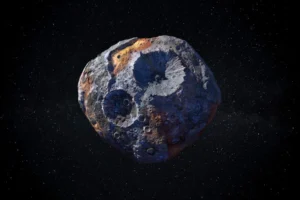
For example, one 10-meter stony (S-type) asteroid could contain up to 650,000 kilograms of iron, nickel, and other metals, including roughly 50 kilograms of gold, platinum, and rhodium.
There’s an asteroid between Mars and Jupiter called 16 Psyche that scientists believe contains over $700 quintillion dollars in gold and other precious metals. That’s a lot of wedding bands and gold coins, and it’s no surprise that this potential value has sparked interest in asteroid mining.
AstroForge and the Odin Mission
AstroForge, one of today’s leading asteroid mining startups, launched its first demonstration spacecraft in 2023.
This past February, the company embarked on its first deep-space mission, Odin. The main goals were to see if their spacecraft could reach deep space (beyond the Moon) and perform a flyby to capture data and imagery of a metal-rich asteroid. Doing so would help validate AstroForge’s models for identifying asteroids suitable for future mining missions.
The spacecraft made it beyond the Moon and briefly communicated with Earth, a major milestone for a small private mission. However, communication problems started early and worsened as the spacecraft moved farther away. As a result, Odin was unable to collect imagery or data from its target asteroid.
While the mission didn’t achieve its primary data-gathering objective, it did demonstrate that AstroForge can build, launch, and operate a relatively low-cost deep-space spacecraft – and provided valuable lessons that will help future missions.
Recycling Gold on Earth
Of all the heavier elements created in space, gold has always had a special place in our hearts. Beyond its luxurious appeal, gold is incredibly versatile, with uses ranging from bullion and jewelry to dental crowns, electronics and more.
The race to mine asteroids is on – and who knows, maybe Garfield Refining will have a location in space one day (woah). But for now, we’re happy to keep refining gold right here on Earth, just as we’ve done for the past 133 years.
Gold is rare – both on Earth and in the universe. In fact, if all the gold ever mined were melted down, it would only fill about three and a half Olympic-size swimming pools. The good news? Precious metals like gold can be recycled infinitely without ever losing quality. And if you have precious metal scrap that you’d like to recycle for cash, Garfield is here to help!
Established in 1892, Garfield Refining has over a century of experience in refining precious metals for individuals, jewelers, pawnbrokers, dental professionals and more. Start your shipment today to cash in on your gold, silver, platinum or palladium.
Written by
Allie BowmanAllie Bowman is the Content Lead at Garfield Refining, where she translates 134 years of precious metals expertise into clear, accurate, and practical content for individual sellers, dental professionals, jewelers, and collectors. A Dean's List graduate of the University of Delaware's Media Communication program, Allie has built her career around making complex subjects accessible to a broad audience. Her experience spans nutrition science, lifestyle magazine publishing, and precious metals refining, giving her a unique ability to transform technical information into engaging, trustworthy content. At Garfield, Allie brings editorial rigor and subject-matter expertise to every piece she produces. She works closely with Garfield's refining specialists and senior leadership to ensure that technical topics - from karat markings and assay methods to precious metals markets and spot price mechanics - are explained with both accuracy and clarity. Since joining Garfield's marketing team, Allie has written extensively on precious metals refining, dental scrap recovery, gold and silver bullion, estate and inherited jewelry, and industry-specific topics for dental and jewelry professionals. All content is reviewed by Garfield's leadership team prior to publication, ensuring it reflects the company's standards for accuracy, transparency, and industry expertise.
Reviewed by
Morgan KerrisseyMorgan Kerrissey is the President of Garfield Refining, one of North America's most longstanding and trusted precious metals refineries. For over two decades, Morgan has built his career at the intersection of commodities markets, metallurgy, and precious metals — earning a reputation as one of the most knowledgeable voices in the refining industry. Morgan joined Garfield in 2008, bringing rigorous operational discipline to a company built on exacting standards since 1892. Named President in 2014, he has guided Garfield through volatile gold, silver, and palladium markets, while modernizing its workforce and technologies and diversifying its metal supply chains. Under his leadership, Garfield has expanded its refining capabilities across the full lifecycle of precious metals recovery, entered new markets, and expanded services while maintaining the same customer forward approach that has made Garfield a mainstay for more than a century. From hedging strategy to daily refinery operations, Morgan commands high levels of technical depth and market fluency. Morgan grew up outside Boston, graduated from Harvard University, and has lived with his family in Philadelphia, PA for almost 20 years.