

Last Updated: June 8, 2026
We all know that Santa Claus lives at the North Pole, but what else goes on up there? This fascinating region has inspired legends and explorations for centuries. Located in the Arctic, the North Pole is the farthest northern point on the globe. Most people will never set foot there, but the Garfield team couldn’t help but wonder: is there gold at the North Pole?
What’s It Like at the North Pole?
The geographic North Pole sits at the top of the planet and differs greatly from its southern counterpart in Antarctica. Unlike the South Pole, which rests on a permanent land mass, the North Pole lies on a shifting sea ice cap in the Arctic Ocean. Due to decades of global warming, the ice cap has been shrinking at an accelerating rate.
Wildlife at the North Pole is on the sparse side because conditions are so extreme. While animals like polar bears, seals, Arctic foxes and birds like the snow bunting have been spotted near the North Pole, most tend to stay farther south in the Arctic where’s there more food available.
Exploring the Arctic
Only five countries border the Arctic: the United States (via Alaska), Canada, Denmark (via Greenland), Norway and Russia. But as it currently stands, no nation officially owns the North Pole itself.
Explorers began attempting to reach the North Pole in the late 19th century, and it was finally reached in 1926 by air, since no stable land route existed. The region’s extreme remoteness and mystery fueled global curiosity about what resources might be hidden there.
Yukon Gold Prospecting
Unsurprisingly, the promise of gold prompted the first major population boom in the Arctic. In the late 1800s, news of gold discoveries in the Yukon territory of northern Canada spread rapidly. Prospectors from around the world rushed north during what became known as the Klondike Gold Rush.
This mining frenzy popularized pyrite, or “fool’s gold,” which was common in the region and often mistaken for real gold. The Klondike Gold Rush not only transformed the Yukon but also ignited global interest in Arctic mineral exploration.
Today, as rising temperatures continue to melt ancient glaciers, the Arctic is entering a new era of discovery. Vast mineral deposits – including precious metals – are being revealed, sparking renewed interest from governments and corporations alike.
Gold in the Arctic Today
In the nearly 150 years since the Klondike Gold Rush, the Arctic has been extensively mined – particularly in northern Canada and Russia. Mining now accounts for roughly half of the income in Canada’s Northwest Territories.
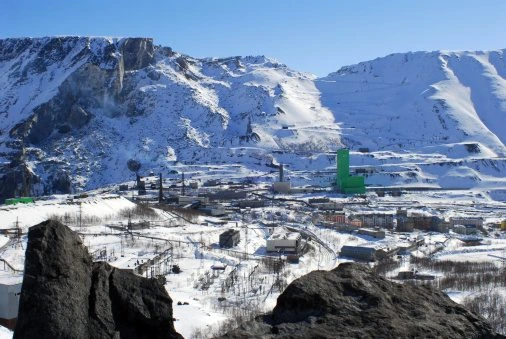
Greenland is believed to be rich in uranium, rare earth elements and precious metals like gold. Much of its mineral wealth remains untouched, and the region may be on the brink of a significant mining boom.
Alaska also has its fair share of resources, holding about 3.5% of the world’s gold and 1.5% of the world’s silver. However, Arctic mining is difficult and expensive due to the extremely cold temperatures and remote locations.
So, Does Gold Exist at the North Pole Itself?
While gold is abundant throughout the Arctic region, there is currently no confirmed evidence of gold directly at the North Pole. If there is gold there, it’s buried beneath thousands of feet of Arctic seawater – still out of reach of economically viable mining methods.
Are Gold Reserves Dwindling?
This slowdown in gold production has led some experts to explore alternative sources of gold, including the ocean floor. While scientists agree the gold does exist beneath the oceans, they remain uncertain about practical and environmentally responsible methods for extracting it.
Global mine production has essentially plateaued over the past 5-7 years, and many historically productive regions are in decline. The U.S. Geological Survey estimates that only 54,000-57,000 metric tons of identified economic gold reserves remain worldwide. And at current mining rates of roughly 3,000-3,300 tons per year, the known reserves could be significantly depleted by 2040–2050 if no major new discoveries are made.
The Growing Importance of Recycling
Mine production still supplies about 75% of the world’s gold each year, but global demand usually exceeds what is newly mined. The remainder is made up through recycling, a crucial source of precious metals. The majority of recycled gold comes from jewelry, but dental scrap and electronics are also significant sources of precious metal scrap.
Recycle with Confidence at Garfield Refining
Precious metal prices are at historic highs. Gold recently surpassed $4,200 per ounce, and silver has reached $60 per ounce. Now is the perfect time to sell any unwanted precious metal scrap you may have, whether it’s gold or silver jewelry, trinkets, flatware or even an old dental crown.
Working with a reputable precious metals refinery ensures you’ll receive the highest possible payout for your material. For reliable, convenient refining, look no further than Garfield!
Ready to recycle your gold, silver, platinum, or palladium for cash? Download a free shipping label and get started today!
Written by
Allie BowmanAllie Bowman is the Content Lead at Garfield Refining, where she translates more than 130 years of precious metals expertise into clear, accurate, and practical content for individual sellers, dental professionals, jewelers, and collectors. A Dean's List graduate of the University of Delaware's Media Communication program, Allie has built her career around making complex subjects accessible to a broad audience. Her experience spans nutrition science, lifestyle magazine publishing, and precious metals refining, giving her a unique ability to transform technical information into engaging, trustworthy content. At Garfield, Allie brings editorial rigor and subject-matter expertise to every piece she produces. She works closely with Garfield's refining specialists and senior leadership to ensure that technical topics - from karat markings and assay methods to precious metals markets and spot price mechanics - are explained with both accuracy and clarity. Since joining Garfield's marketing team, Allie has written extensively on precious metals refining, dental scrap recovery, gold and silver bullion, estate and inherited jewelry, and industry-specific topics for dental and jewelry professionals. All content is reviewed by Garfield's leadership team prior to publication, ensuring it reflects the company's standards for accuracy, transparency, and industry expertise.
Reviewed by
Morgan KerrisseyMorgan Kerrissey is the President of Garfield Refining, one of North America's most longstanding and trusted precious metals refineries. For over two decades, Morgan has built his career at the intersection of commodities markets, metallurgy, and precious metals — earning a reputation as one of the most knowledgeable voices in the refining industry. Morgan joined Garfield in 2008, bringing rigorous operational discipline to a company built on exacting standards since 1892. Named President in 2014, he has guided Garfield through volatile gold, silver, and palladium markets, while modernizing its workforce and technologies and diversifying its metal supply chains. Under his leadership, Garfield has expanded its refining capabilities across the full lifecycle of precious metals recovery, entered new markets, and expanded services while maintaining the same customer forward approach that has made Garfield a mainstay for more than a century. From hedging strategy to daily refinery operations, Morgan commands high levels of technical depth and market fluency. Morgan grew up outside Boston, graduated from Harvard University, and has lived with his family in Philadelphia, PA for almost 20 years.