
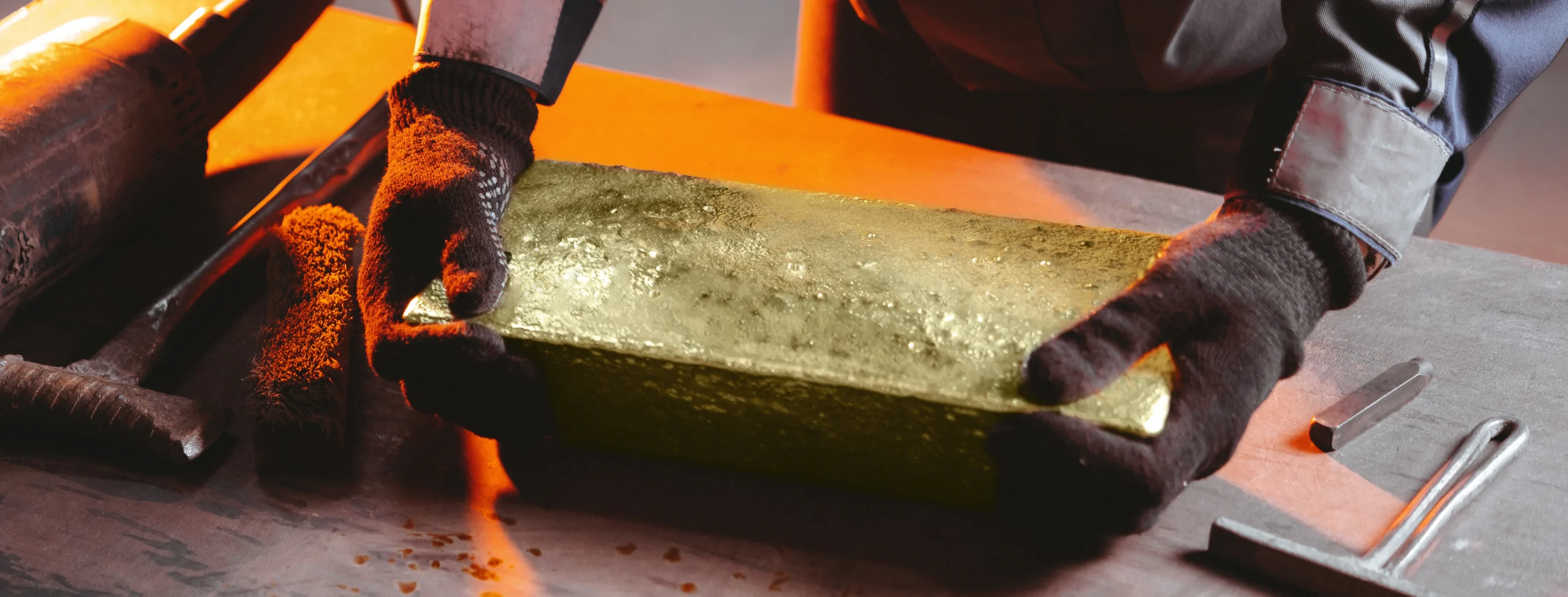
At Garfield Refining, we’ve had many curious clients ask what happens to their precious metals once they’re refined. This is a great question that highlights one of the most interesting aspects of metal recycling: the material that you send us could end up in many different places, shapes and forms!
Precious metals like gold, silver, platinum, and palladium are endlessly recyclable without losing any of their original quality. For example, a gold dental crown that we receive could be refined, processed and shipped off to a jewelry manufacturer, where the gold is eventually used to make a piece of jewelry. (Yes, the gold in your favorite necklace could have lived a past life in someone’s mouth!) That’s the beauty of precious metals refining – you never know where your recycled metal might end up next.
Who Uses Recycled Metals?
Once we receive your precious metals, they are melted, purified, and cast into bars that meet our buyers’ criteria. These bars are then reintroduced into the market, serving various industries. Your metals might go to jewelry manufacturers and fabricators, bullion and coin manufacturers, financial companies looking to own physical metal, or industrial companies who create components for automobiles, medical devices and more.
Who Gets the Gold?
Gold serves many interesting uses beyond jewelry and bullion. From dental restorations to electronic components and even edible applications, gold is a very versatile metal. But some things never really change, and gold’s global demand is still primarily driven by the financial sector, central banks, and jewelry fabrication.
What About Silver?
While silver typically doesn’t get as much attention as gold, we think it’s just as great in many ways. This shiny white metal does it all. Along with gold, silver is a staple in the jewelry and investment sectors, but it also has many interesting, more niche industrial uses.
Silver has always been used as a form of currency, but its less common uses have evolved throughout history from an antibacterial agent to a key player in the photography industry, and a component of mirrors, windows, and air conditioning systems. Along with jewelry and bullion production, much of the silver we refine may be used industrially for things like solar panels, electronics, water filtration and more.
Platinum Group Metals
The platinum group metals that we refine (platinum and palladium) are often sent to manufacturers of automobile components and medical devices. PGMs are indispensable in the automotive industry, as they serve a vital function in catalytic converters by facilitating oxidation reactions that convert pollutants into less harmful substances. Interestingly, PGMs are also used in the production of glass products.
Platinum group metals are very rare and can be expensive to mine, with limited reserves in specific areas like South Africa and Russia. Certain platinum group metals trade in very thin markets, which makes their prices particularly volatile at times. They’re among the most expensive metals, which makes recycling crucial. Recycling PGMs from end-of-life products is often a much more cost-effective practice than primary extraction.
The Recycled Metal Supply Chain
Because precious metals hold such a high inherent value, people have been finding ways to recycle them for thousands of years. Ancient civilizations used techniques like cupellation to refine silver as far back as 2,500 BC!
Today, the demand for recycled metals is growing as consumers seek more sustainable products and businesses start to prioritize environmental transparency. According to the World Gold Council, recycled gold now accounts for roughly 30% of the world’s annual supply, while recycled silver makes up about 20-25%.
Many industry leaders are embracing the use of recycled precious metals. For example, Pandora, the world’s largest jewelry maker, transitioned to using 100% recycled gold and silver in 2024, reflecting a broader push toward sustainability.
Environmental Upsides
Recycling precious metals isn’t just a smart financial decision – it’s also an eco-friendly one. Recycling gold, for example, requires significantly less energy and produces a smaller carbon footprint than primary extraction through mining.
Precious metal scrap – whether it’s old jewelry, dental crowns, or silverware – holds significant value, both monetarily and resource-wise. By recycling your scrap with a refinery like Garfield, you can contribute to a circular economy by reducing dependence on primary metal extraction.
Do you have precious metal scrap that you’d like to recycle? Garfield is North America’s trusted leader in refining, providing our customers with the highest possible payout. Get started today by downloading a free shipping label for your items!
Questions about the refining process, payments or accepted materials? No problem – get in touch with our expert team today by calling 888-804-9716 or emailing info@garfieldrefining.com.
Written by
Allie BowmanAllie Bowman is the Content Lead at Garfield Refining, where she translates more than 130 years of precious metals expertise into clear, accurate, and practical content for individual sellers, dental professionals, jewelers, and collectors. A Dean's List graduate of the University of Delaware's Media Communication program, Allie has built her career around making complex subjects accessible to a broad audience. Her experience spans nutrition science, lifestyle magazine publishing, and precious metals refining, giving her a unique ability to transform technical information into engaging, trustworthy content. At Garfield, Allie brings editorial rigor and subject-matter expertise to every piece she produces. She works closely with Garfield's refining specialists and senior leadership to ensure that technical topics - from karat markings and assay methods to precious metals markets and spot price mechanics - are explained with both accuracy and clarity. Since joining Garfield's marketing team, Allie has written extensively on precious metals refining, dental scrap recovery, gold and silver bullion, estate and inherited jewelry, and industry-specific topics for dental and jewelry professionals. All content is reviewed by Garfield's leadership team prior to publication, ensuring it reflects the company's standards for accuracy, transparency, and industry expertise.
Reviewed by
Morgan KerrisseyMorgan Kerrissey is the President of Garfield Refining, one of North America's most longstanding and trusted precious metals refineries. For over two decades, Morgan has built his career at the intersection of commodities markets, metallurgy, and precious metals — earning a reputation as one of the most knowledgeable voices in the refining industry. Morgan joined Garfield in 2008, bringing rigorous operational discipline to a company built on exacting standards since 1892. Named President in 2014, he has guided Garfield through volatile gold, silver, and palladium markets, while modernizing its workforce and technologies and diversifying its metal supply chains. Under his leadership, Garfield has expanded its refining capabilities across the full lifecycle of precious metals recovery, entered new markets, and expanded services while maintaining the same customer forward approach that has made Garfield a mainstay for more than a century. From hedging strategy to daily refinery operations, Morgan commands high levels of technical depth and market fluency. Morgan grew up outside Boston, graduated from Harvard University, and has lived with his family in Philadelphia, PA for almost 20 years.