
Last Updated: June 8, 2026
Have you ever wondered about those tiny letters or numbers on the underside of your gold jewelry? These markings serve as great clues about the gold’s authenticity, purity, and sometimes even its origin.
Whether you’re inheriting, buying or selling gold jewelry, understanding markings is a crucial part of gauging value and avoiding counterfeit items. Take the Cartier LOVE bracelet for example. This is one of the most popular – and replicated – pieces of jewelry out there. Knowing exactly which markings to look for helps you distinguish knock-offs from the real deal.
There are two main types of markings on gold jewelry items: production hallmarks and karat stamps. They’re both important but serve different purposes.
Production Hallmarks
Hallmarks date back to medieval Europe, where they were among the earliest forms of consumer protection. Initially, they indicated the purity of gold and the certifying assayer’s office. Over time, hallmarks evolved to include additional details, such as the goldsmith’s identity. In fact, the term “hallmark” originates from the Goldsmiths’ Hall in London circa 1327.
Today, production hallmarks convey a wealth of information about a jewelry piece, including:
- Purity Mark (Fineness Mark): Shows the gold’s purity, often expressed in karats (e.g., 10k, 14k, 18k) or parts per thousand (e.g., 585, 750). For example: “14k” denotes 58.5% gold content.
- Maker’s Mark: A unique symbol or initials identifying the manufacturer or brand. Ensures traceability to the producer.
- Assay Office Mark: This is an optional mark from an official assay office or certifying body that tested and verified the gold’s quality.
- Country or Regional Mark: Identifies the country or region where the jewelry was produced or hallmarked. Example: A “585” mark with additional stamps like a lion for the UK or an eagle head for France.
- Date Letter: Indicates the year of production – a common marking in the UK.
Additional Markings for Gold Composition
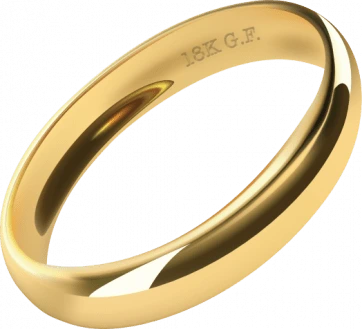
These specialized markings describe the specific method that was used to incorporate gold into the jewelry piece. This is where it gets interesting!
- GF, gf, G.F. (Gold Filled): A thin layer of gold that’s at least 10 karats is wrapped around a much less valuable piece of base metal like brass or bronze. The gold can make up as little as 5% of the item’s weight.
- GO, go, G.O. (Gold Overlay)/RGP, R.G.P. (Rolled Gold Plate): An even thinner layer of gold is bonded to another metal. Gold only makes up about 2.5% of the total weight!
- HGE, hge, H.G.E. (Heavy Gold Electroplated): An incredibly fine layer of gold is fused to a base metal. It has a minimum thickness of 2.5 microns, which is several times thinner than a strand of human hair.
- GP, gp, G.P. (Gold Plated)/GEP, G.E.P. (Gold Electroplated): Like HGE, this is an extremely thin layer of gold with a minimum thickness of 7 millionths of an inch.
- V (Vermeil): A layer of gold is bonded to sterling silver with a minimum thickness of 2.5 microns.
Gold filled jewelry is required by law to contain at least 5% gold, while other options such as gold plated and vermeil usually have under 0.05% gold. Gold filled is a great middle ground between gold plated and solid gold: it’s generally tarnish-resistant and can last a lifetime with proper care, but it won’t break the bank.
Karat Stamps
The karat rating system for gold is believed to date all the way back to ancient coin-measuring practices. It’s important not to confuse “karat” for gold content with “carat” for the weight of a gemstone.
In the U.S., all solid gold jewelry of at least 10 karats must bear a karat stamp, as required by the 1906 National Gold and Silver Marking Act. Common karat ratings include:
- 10k (41.7% gold): Durable and affordable, often used in everyday jewelry.
- 14k (58.5% gold): A popular choice for its balance of purity and durability.
- 18k (75% gold): More luxurious and softer than 14k.
- 24k (100% gold): Pure gold, but impractical for daily wear due to its softness.
To clarify: while 10k gold-filled jewelry contains a thin layer of 10-karat gold, a 10k solid gold stamp signifies that 41.7% of the entire piece is gold.
Why Gold Jewelry Markings Matter
As you can see, some types of “gold jewelry” contain very small amounts of actual gold. Without hallmarks and karat stamps, it’s hard to discern whether an item is solid gold, gold filled or gold plated. If you’re considering selling your gold jewelry based on its raw material value, understanding these markings is crucial. If you’re ready to sell, our guide for individual sellers walks you through the entire process.
Our Experts Are Here to Help
At Garfield Refining, we specialize in determining the value of gold, silver, platinum, and palladium jewelry. Our scientific melt and assay process ensures accurate measurements of precious metal content, which we then use to calculate payments based on current market prices. Since 1892, we’ve been committed to providing our clients with the highest possible payouts for their precious metal scrap!
Garfield Refining buys all used gold, gold-filled, platinum, and silver jewelry for the fair market value of precious metal content only. We don’t appraise jewelry on artistry, brand, or vintage.
If you have gold, silver, platinum or palladium scrap that you’re looking to sell, give us a call or start your free shipment today!
Written by
Allie BowmanAllie Bowman is the Content Lead at Garfield Refining, where she translates more than 130 years of precious metals expertise into clear, accurate, and practical content for individual sellers, dental professionals, jewelers, and collectors. A Dean's List graduate of the University of Delaware's Media Communication program, Allie has built her career around making complex subjects accessible to a broad audience. Her experience spans nutrition science, lifestyle magazine publishing, and precious metals refining, giving her a unique ability to transform technical information into engaging, trustworthy content. At Garfield, Allie brings editorial rigor and subject-matter expertise to every piece she produces. She works closely with Garfield's refining specialists and senior leadership to ensure that technical topics - from karat markings and assay methods to precious metals markets and spot price mechanics - are explained with both accuracy and clarity. Since joining Garfield's marketing team, Allie has written extensively on precious metals refining, dental scrap recovery, gold and silver bullion, estate and inherited jewelry, and industry-specific topics for dental and jewelry professionals. All content is reviewed by Garfield's leadership team prior to publication, ensuring it reflects the company's standards for accuracy, transparency, and industry expertise.
Reviewed by
Morgan KerrisseyMorgan Kerrissey is the President of Garfield Refining, one of North America's most longstanding and trusted precious metals refineries. For over two decades, Morgan has built his career at the intersection of commodities markets, metallurgy, and precious metals — earning a reputation as one of the most knowledgeable voices in the refining industry. Morgan joined Garfield in 2008, bringing rigorous operational discipline to a company built on exacting standards since 1892. Named President in 2014, he has guided Garfield through volatile gold, silver, and palladium markets, while modernizing its workforce and technologies and diversifying its metal supply chains. Under his leadership, Garfield has expanded its refining capabilities across the full lifecycle of precious metals recovery, entered new markets, and expanded services while maintaining the same customer forward approach that has made Garfield a mainstay for more than a century. From hedging strategy to daily refinery operations, Morgan commands high levels of technical depth and market fluency. Morgan grew up outside Boston, graduated from Harvard University, and has lived with his family in Philadelphia, PA for almost 20 years.