
Last Updated: April 23, 2026
Karat’ and ‘carat’ are both common terms in the jewelry world. While these two words may sound the same, they have completely distinct meanings. ‘Karat’ is used to signify the percentage of gold in jewelry, while ‘carat’ indicates the weight of a diamond.
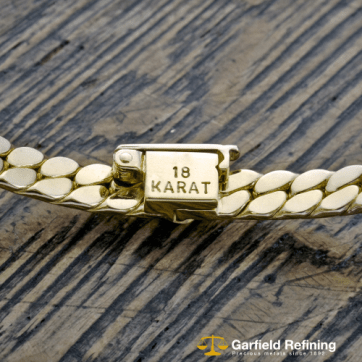
If you’re trying to determine the exact composition of your gold or silver jewelry, maker’s marks and karat stamps are a great place to start – provided you know how to interpret them. Here’s a quick rundown on karat ratings and how they can vary across different countries!
What Are Gold Karat Ratings?
Authentic gold jewelry must have a karat rating for legal advertisement and sale. Karat ratings are based on a 24-part system that’s rooted in historical goldsmithing practices, dating back centuries. The origin of ‘karat’ is thought to be connected to ‘carat,’ which came first.
The 24-karat rating system for gold is believed to stem from ancient coinage and measurement practices. In medieval times, particularly in the Byzantine Empire, the gold solidus coin was widely used. This coin was approximately 24 carats (the unit of weight used for gemstones and pearls). Interestingly, the word ‘carat’ stems from the Greek word “kerátion” meaning “carob seed.” The carob seed was used as a point of reference because of its relatively uniform weight.
Measuring the purity of gold in parts of 24 likely comes from the carat weight of the solidus coin, and the desire for a simple, assessing method. Using 24 as the denominator also made practical sense because 24 is a highly divisible number. This made calculations and trading easier, which was especially helpful long before calculators were invented.
The karat ratings for gold jewelry are as follows:
- 24k, 24K, 24 karat (pure gold): at least 99.95% gold by weight; 24 parts gold
- 18k, 18K, 18 karat: at least 75.00% gold by weight; 18 parts gold to 6 parts other metal
- 14k, 14K, 14 karat: at least 58.33% gold by weight; 14 parts gold to 10 parts other metal
- 10k, 10K, 10 karat: at least 41.67% gold by weight; 10 parts gold to 14 parts other metal
Tolerances in Gold Karat Quality Ratings
When it comes to exactly how pure gold jewelry is, no two pieces are identical. The FTC monitors minor variations in gold content to ensure that products receive proper labeling within a certain scale of purity. This means that the exact percentage of gold in an item may slightly differ within the range allowed for a given karat rating. You can visit MJSA for more information on tolerances in gold jewelry.
What About Other Markings?
The expression of karat ratings can differ based on an item’s country of origin. Most European jewelers use three-digit numbers to specify the percentage of gold in their jewelry. For example, 999 indicates 99.9% pure gold (24 karats), 750 indicates 75.0% pure gold (18 karats), and so on.
You may also come across a “ct” which is commonly used in the UK and other countries to express the karat rating of gold. There is where it can get a bit confusing – 24ct (24 carats) can be used interchangeably with 24k (24 karats). Karat is usually spelled with a “K” in the United States, Canada and Japan. And then there’s carat, commonly spelled with a “C” in the UK, Australia, New Zealand and South Africa. Neither of these, however, should be confused with “carat” as in the weight of a gemstone!
How Our Experts Can Help
While karat stamps and maker’s marks are great starting points to gauge the composition of your jewelry, they don’t guarantee the indicated purity. Despite universal karat systems and FTC regulations, there will always be some companies in the jewelry industry who bend the rules and maybe even sell fake gold.
If you ever end up with gold jewelry that you’re looking to sell, having a refinery like Garfield perform a melt and assay is the best way to discover exactly how much gold it contains. Sending gold, silver or platinum jewelry to a trusted refinery will guarantee that you receive the maximum value from its precious metal contents!
Garfield Refining buys all used gold, gold-filled, platinum, and silver jewelry for the fair market value of precious metal content only. We don’t appraise jewelry on artistry, brand, or vintage. If you have antique jewelry that you’re looking to evaluate, check out our blog post on Antique Gold Jewelry to learn more.
If you’re looking to sell gold jewelry, fill out this form to get started today!
Written by
Allie BowmanAllie Bowman is the Content Lead at Garfield Refining, where she translates more than 130 years of precious metals expertise into clear, accurate, and practical content for individual sellers, dental professionals, jewelers, and collectors. A Dean's List graduate of the University of Delaware's Media Communication program, Allie has built her career around making complex subjects accessible to a broad audience. Her experience spans nutrition science, lifestyle magazine publishing, and precious metals refining, giving her a unique ability to transform technical information into engaging, trustworthy content. At Garfield, Allie brings editorial rigor and subject-matter expertise to every piece she produces. She works closely with Garfield's refining specialists and senior leadership to ensure that technical topics - from karat markings and assay methods to precious metals markets and spot price mechanics - are explained with both accuracy and clarity. Since joining Garfield's marketing team, Allie has written extensively on precious metals refining, dental scrap recovery, gold and silver bullion, estate and inherited jewelry, and industry-specific topics for dental and jewelry professionals. All content is reviewed by Garfield's leadership team prior to publication, ensuring it reflects the company's standards for accuracy, transparency, and industry expertise.
Reviewed by
Morgan KerrisseyMorgan Kerrissey is the President of Garfield Refining, one of North America's most longstanding and trusted precious metals refineries. For over two decades, Morgan has built his career at the intersection of commodities markets, metallurgy, and precious metals — earning a reputation as one of the most knowledgeable voices in the refining industry. Morgan joined Garfield in 2008, bringing rigorous operational discipline to a company built on exacting standards since 1892. Named President in 2014, he has guided Garfield through volatile gold, silver, and palladium markets, while modernizing its workforce and technologies and diversifying its metal supply chains. Under his leadership, Garfield has expanded its refining capabilities across the full lifecycle of precious metals recovery, entered new markets, and expanded services while maintaining the same customer forward approach that has made Garfield a mainstay for more than a century. From hedging strategy to daily refinery operations, Morgan commands high levels of technical depth and market fluency. Morgan grew up outside Boston, graduated from Harvard University, and has lived with his family in Philadelphia, PA for almost 20 years.