

Refining fine jewelry that you no longer need is a great way to earn extra cash. Whether you’re an individual who just inherited some gold or silver jewelry, a budding metalsmith, or a veteran jeweler, preparing your materials mindfully and working with a reputable refinery will help you maximize the value of your metals. From the experts at Garfield Refining, here’s how to refine jewelry scrap like a pro.
Gather Your Scrap
First you’ll want to round up your jewelry and assess what you have. If you’re new to gold jewelry, check out our guide on different types of gold pieces. Gold quantity and purity varies widely, so it’s important to know the difference between gold-plated, gold-filled, gold vermeil, and solid gold items. Karat stamps and hallmarks will provide helpful clues.
When it comes to silver, look for the “925” stamp, indicating sterling silver: 92.5% silver, 7.5% copper. Sterling silver is the most common type of silver jewelry because it offers the ideal balance of purity and strength. (Pure silver is naturally soft, making it too delicate for long-lasting jewelry.)
For platinum pieces, stamps may include “PT”, “PLAT”, “950” or “900.” The numbers represent purity in parts per thousand, standards set under the FTC’s Jewelry Guides.
Gemstone Removal
If your jewelry contains precious gemstones, it’s smart to have the stones removed before sending the pieces to a refinery. Precious metal refineries don’t pay for gemstones, only the metal — but you could keep the stones to sell elsewhere, or even consider having a new custom piece made using them. If the stones are non-precious and you don’t want or need them, there’s no need to remove them before refining.
Sort Your Scrap by Metal Type
Pre-sorting your jewelry scrap by metal type will simplify the refining process and make it easier to understand the metal breakdown on your assay report. This will also give you a better idea of your scrap’s value before sending it in for refining.
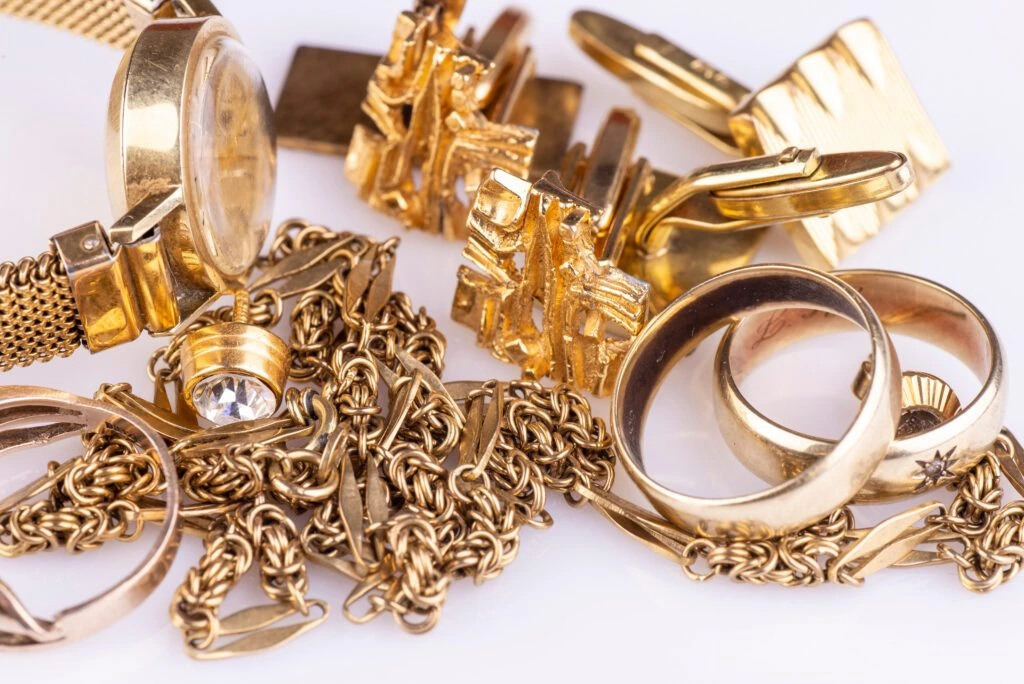
However, sometimes it’s not necessary or simply too difficult to separate your metals while packaging them to refine. It makes sense to leave your material as-is when collecting sweeps or very small scrap clippings. Some jewelers accumulate vacuum bags containing fragments of gold and silver, or workbench carpets that have collected tiny pieces from grinding and filing. These types of materials are generally classified as sweeps, and you’d be unable to separate metals.
We also work with permanent jewelry artists who save tiny clippings from sterling silver and gold-filled chains in one scrap pile and then send it in for refining. In this case, one mixed pile is no big deal – however, we do recommend saving clippings in separate gold and silver bags if that fits into your workflow.
Pre-sorting your metals matters the most for larger lots of jewelry. Although sending mixed materials together won’t decrease your overall value, it can make it harder to see where that value comes from. For instance, combining karat gold with gold-filled items will lower the process alloy’s overall purity and make it hard to decipher how much each category of jewelry was worth. While the total value remains the same, packaging like-materials separately allows for a clearer view of your recovered scrap value.
Your metal can be sorted into the following categories:
- – Gold-filled
- – Silver
- – Platinum
- – Gold: 10k, 14k, 18k, 20k, etc
Unmarked Pieces
If you have unmarked pieces that cannot be identified, be sure to set them aside separately from your stamped pieces. You don’t want unmarked pieces adding weight to your known-gold pile, for example, because if the pieces aren’t real gold or contain only a small amount of gold, mixing them in with the rest can make it seem like your pile contains more value than it actually does. Unmarked pieces can be tested to verify precious metal content before they’re melted down, and if they don’t contain any precious metals, we can send them back to you.
Antique Jewelry
If you have anything that you know or suspect is an antique or rare piece, set it aside for further assessment. Some pieces may have a higher resale value than their metal value alone, especially if they have historical significance, unique craftsmanship, or collector appeal. You may want to get rare or antique pieces appraised before refining them.
Prepare Your Shipment
When you work with an award-winning refinery like Garfield, preparing to ship your items is simple. Just fill out our quick web form and we’ll send you a prepaid shipping label. We’ll also send you a Payment Preference Form to include with your shipment. This is where you can select your payment method, helping us process your payment as soon as possible upon receiving and refining your items. We offer a variety of payment options, including cash, check, ACH, and bullion exchange.
Ship and Get Paid
If you need containers or a box to send us your scrap, we can provide those supplies as well – just give us a call or email info@garfieldrefining.com.
Place your scrap in a box or padded envelope, along with your Payment Preference Form. Seal your package, attach the prepaid shipping label, and drop it off at your nearest post office.
Once we receive your shipment, we’ll send you an email to confirm that it’s safe at our facility. You’ll then be paid within just 1–3 business days. And if you ever have any questions throughout the process, our team of experts is just a phone call away.
America’s Trusted Refinery
Garfield Refining has provided expert refining services since 1892. We proudly serve a variety of clients, including jewelers, pawnbrokers, dentists, individual sellers and more. As a fourth-generation family-owned business, we’re known for industry-leading payouts and award-winning service!
Ready to refine your jewelry or other precious metal items? Download a free shipping label to get started.
Written by
Allie BowmanAllie Bowman is the Content Lead at Garfield Refining, where she translates 134 years of precious metals expertise into clear, accurate, and practical content for individual sellers, dental professionals, jewelers, and collectors. A Dean's List graduate of the University of Delaware's Media Communication program, Allie has built her career around making complex subjects accessible to a broad audience. Her experience spans nutrition science, lifestyle magazine publishing, and precious metals refining, giving her a unique ability to transform technical information into engaging, trustworthy content. At Garfield, Allie brings editorial rigor and subject-matter expertise to every piece she produces. She works closely with Garfield's refining specialists and senior leadership to ensure that technical topics - from karat markings and assay methods to precious metals markets and spot price mechanics - are explained with both accuracy and clarity. Since joining Garfield's marketing team, Allie has written extensively on precious metals refining, dental scrap recovery, gold and silver bullion, estate and inherited jewelry, and industry-specific topics for dental and jewelry professionals. All content is reviewed by Garfield's leadership team prior to publication, ensuring it reflects the company's standards for accuracy, transparency, and industry expertise.
Reviewed by
Morgan KerrisseyMorgan Kerrissey is the President of Garfield Refining, one of North America's most longstanding and trusted precious metals refineries. For over two decades, Morgan has built his career at the intersection of commodities markets, metallurgy, and precious metals — earning a reputation as one of the most knowledgeable voices in the refining industry. Morgan joined Garfield in 2008, bringing rigorous operational discipline to a company built on exacting standards since 1892. Named President in 2014, he has guided Garfield through volatile gold, silver, and palladium markets, while modernizing its workforce and technologies and diversifying its metal supply chains. Under his leadership, Garfield has expanded its refining capabilities across the full lifecycle of precious metals recovery, entered new markets, and expanded services while maintaining the same customer forward approach that has made Garfield a mainstay for more than a century. From hedging strategy to daily refinery operations, Morgan commands high levels of technical depth and market fluency. Morgan grew up outside Boston, graduated from Harvard University, and has lived with his family in Philadelphia, PA for almost 20 years.