
In honor of Valentine’s Day, we’ve gathered some fun facts about the most romantic gold alloy: rose gold. While we love all forms of precious metals (don’t sleep on silver), rose gold has a unique history that’s worth exploring.
How Much is Rose Gold Worth?
Sometimes people ask us: Is rose gold worth more than yellow or white gold? While a particular piece of jewelry may be “worth more” from an artistic perspective, rose gold is not “worth more” because of its metal components. That said, the value of a particular piece of jewelry depends on its metallic components and karat value. White gold, for example, is an alloy of gold and silver. Because silver is more expensive than copper, a white gold ring will be valued more than a rose gold ring of the same karat value. As with most jewelry, its scrap value depends primarily on the percentage of pure gold it contains and the gold’s current market prices.
When it comes to purity, 14k and 18k are the most common types of rose gold. Yellow gold, however, is available in a wider range, typically from 10k to 22k. All in all, 14k is the most popular choice for gold jewelry because it strikes a nice balance between durability and affordability.
Gold + Copper = Rose Gold
Rose gold is often associated with love and romance. It’s made of gold and copper, and sometimes a small amount of silver. The standard proportions for 18k rose gold, for example, are roughly 75% gold, 22.5% copper, and 2.5% silver. Higher-karat alloys (like 18k and 22k) with more gold have a subtle rosy hue, whereas 14k alloys with less gold have a deeper red tint.
Copper does more than give rose gold its distinctive hue – it also strengthens the alloy, enhancing its resistance to scratches and dents. In fact, rose gold is more durable than both yellow and white gold of the same karat, making it an excellent choice for life-long, daily-wear pieces like engagement and wedding rings.
Russian Roots
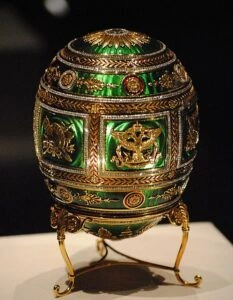
Rose gold was invented in the early 19th century by renowned Russian goldsmith and jeweler Peter Carl Fabergé, best known for his famous Fabergé Eggs. The alloy was so popular in imperial Russia that it was originally called ‘Russian gold.’
Rose gold became a stylish choice for fine jewelry in the Victorian era, and by the 1920s it made its way into American popular culture. Bold designs and multi-colored pieces featuring rose gold were prominent throughout the Art Deco period.
The Rise of Rose Gold Engagement Rings
Although rose gold was popular at the time, platinum was the preferred metal for engagement rings during the Art Deco period, as its strength allowed for the intricate designs of the era. However, when World War II began, platinum was declared a strategic material – its uses span far beyond jewelry – and was restricted for military and industrial use. This led to a rise in the popularity of gold engagement rings, including rose gold, during the 1940s.
Rose gold remains popular, no longer out of necessity, but as a fashion choice. Celebrities like Mandy Moore, Blake Lively and Lauren Conrad have all sported rose gold engagement rings. Aside from its unique rosy hue, rose gold is a practical ring choice because it pairs well with almost everything, and high-quality pieces will last a lifetime.
Cartier and the Trinity Ring
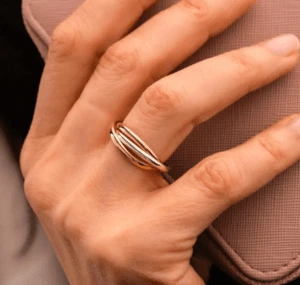
Cartier’s iconic Trinity Ring, featuring intertwined white, yellow and rose gold bands, helped elevate rose gold’s status in fine jewelry. First introduced at the 1925 Paris Exposition, the design debuted alongside other bold and colorful creations that defined the era’s opulent style.
Mixed-metal, trinity-style rings, bracelets and even necklaces have remained popular to this day. In fact, it’s easy to find spin-offs of Cartier’s Trinity from smaller jewelers that offer a similar aesthetic without breaking the bank.
The trinity design has stood the test of time because it’s versatile, genderless and symbolic. Some say that the rose gold stands for love, white gold stands for friendship and yellow gold stands for loyalty. Others see the three golds as emblems of diversity and universality.
Buying and Selling Rose Gold
Thinking about buying some rose gold for your Valentine? Check out our guide to different types of gold jewelry and you’ll be armed with knowledge in no time.
Looking to sell some broken, mismatched or unwanted gold jewelry? With today’s metal prices, even just a small amount of gold scrap could be worth more than you think. Garfield Refining is North America’s premier precious metals refinery, providing our clients with the highest possible payments for gold and other precious metals. Based in Philadelphia, we’ve been servicing jewelers and individual sellers since 1892.
Ready to sell your precious metal scrap? Get started with a free shipping label!
Written by
Allie BowmanAllie Bowman is the Content Lead at Garfield Refining, where she translates more than 130 years of precious metals expertise into clear, accurate, and practical content for individual sellers, dental professionals, jewelers, and collectors. A Dean's List graduate of the University of Delaware's Media Communication program, Allie has built her career around making complex subjects accessible to a broad audience. Her experience spans nutrition science, lifestyle magazine publishing, and precious metals refining, giving her a unique ability to transform technical information into engaging, trustworthy content. At Garfield, Allie brings editorial rigor and subject-matter expertise to every piece she produces. She works closely with Garfield's refining specialists and senior leadership to ensure that technical topics - from karat markings and assay methods to precious metals markets and spot price mechanics - are explained with both accuracy and clarity. Since joining Garfield's marketing team, Allie has written extensively on precious metals refining, dental scrap recovery, gold and silver bullion, estate and inherited jewelry, and industry-specific topics for dental and jewelry professionals. All content is reviewed by Garfield's leadership team prior to publication, ensuring it reflects the company's standards for accuracy, transparency, and industry expertise.
Reviewed by
Morgan KerrisseyMorgan Kerrissey is the President of Garfield Refining, one of North America's most longstanding and trusted precious metals refineries. For over two decades, Morgan has built his career at the intersection of commodities markets, metallurgy, and precious metals — earning a reputation as one of the most knowledgeable voices in the refining industry. Morgan joined Garfield in 2008, bringing rigorous operational discipline to a company built on exacting standards since 1892. Named President in 2014, he has guided Garfield through volatile gold, silver, and palladium markets, while modernizing its workforce and technologies and diversifying its metal supply chains. Under his leadership, Garfield has expanded its refining capabilities across the full lifecycle of precious metals recovery, entered new markets, and expanded services while maintaining the same customer forward approach that has made Garfield a mainstay for more than a century. From hedging strategy to daily refinery operations, Morgan commands high levels of technical depth and market fluency. Morgan grew up outside Boston, graduated from Harvard University, and has lived with his family in Philadelphia, PA for almost 20 years.